Once upon a time, I was thinking about writing a review of Taylor Swift’s ‘1989’. Not for any particular reason, just because I thought it was a good record which had just come out; I like pop music; I like writing things; and, statistically, at least one of my six regular blog readers will be a Taylor Swift fanatic. I sat down to write about Taylor Swift and my brain started thinking about reviews. Welcome to my life.
It appears to me that there are two distinct schools with their own methods when it comes to reviews. The first type of review I like to call ‘The Philip French Observer Film Review Method’ after the method used for reviews of films written for the Observer by Philip French (I am nothing if not a pragmatist when it comes to naming things. My idol is the person who came up with the name ‘Great Sandy Desert’).
For your 2000 words, you’d get 1750 words on any subject other than the film at hand, the intention being to prove how much smarter than you Philip French was. Invariably you’d get references to Marxist theory, post-war Italian cinema and (if the lead was a female) something about Laura Mulvey – unless the lead female was either pregnant or a mother, in which case it would be Creed and Kristeva references.
The final 250 words would be a series of snippish, snarkish asides even if French liked it and the film turned out to be the most popular film of all time. The whole effect is just to prove French’s cerebral superiority as he lathers himself towards an intellectual orgasm over the course of the review before unleashing his egghead ejaculate all over the reader’s face.
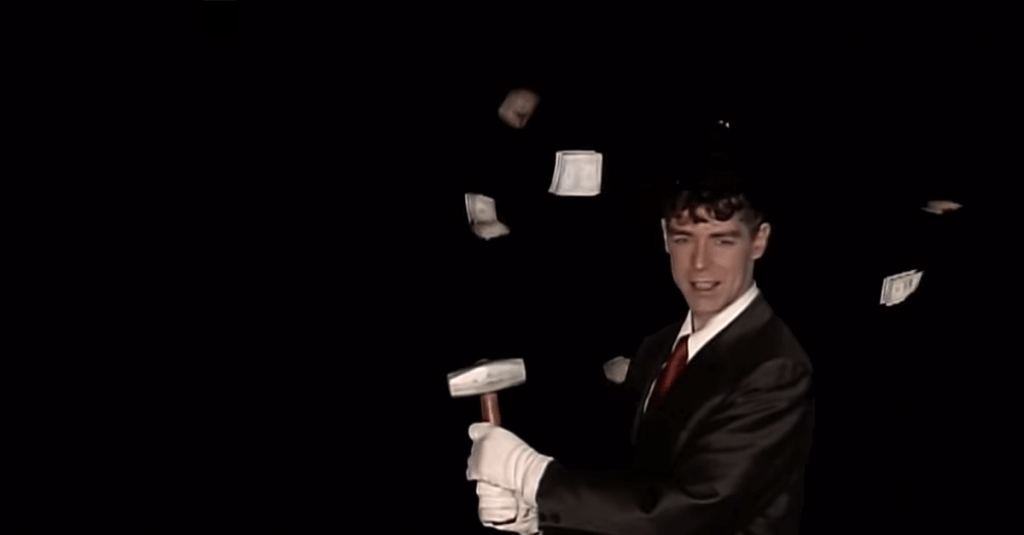
The second type I call ‘The Smash Hits Method‘ and involves writing about the thing being reviewed in a way that describes what it is like and lets readers decide whether they might like it. Consider this video:
Now consider the way that Tom Hibbert described it in Smash Hits in 1985:
“It sounds like Richard Clayderman having a fight with Frankie Goes To Hollywood in a coal scuttle.”
Hibbert could have said that it sounded like pulsing electronic pop dance music full of clever production tricks, catchy keyboard riffs, slightly nasal male vocals, an odd series of arhythmic metallic clanking sounds and two kitchen sinks. He’d have been right, of course, he just didn’t need to; the comment above said all that. No mentions of poststructuralism’s applicability or the mating habits of Pier Paolo Pasolini (by the way, have you read, “Phew, Eh, Readers?”, the posthumous collection of writing by and about Tom Hibbert? Amazing).
In the end, and luckily for you, I couldn’t be bothered to write a review of ‘1989’, not least because everyone from Top Gear to Portable Restroom Operator Magazine wrote a thinkpiece about it. Also because I have the attention span of a squirrel trapped in a barrel full of blue Smarties and I started thinking about something else. And what I thought about was this: why do we only review new music?
In fact, I reflected, the same question can be said of any digital media asset – music, books and films, chiefly. There’s such a clamour to review new ones, but that model doesn’t really reflect the new democracy of digital media. If I look at the new releases on YouTube Music right now, yes, I can see new albums by Dua Lipa and Pet Shop Boys. But I don’t have to scroll far to find ‘new’ releases by The Steve Miller Band (a 1972 album) and Charlie Daniels (from 1973).
Some years ago I participated in the light-hearted campaign to purchase Rage Against The Machine’s ‘Killing In The Name Of’ and keep the latest miming dance monkey from rhomboid-headed pop svengali Simon Cowell off the Christmas number one position. Not because I cared either way, I just liked the record and it was good to hear it on the radio. In fact that remains the only time I’ve listened to the chart rundown since my mid-teens and the only time I’ve listened to Radio 1 since Mark and Lard left, but that’s not the point.
The whole campaign was only possible because iDevice owners could go online and download the song from the iTunes store, and purchases made that way counted towards chart positions. Now things have moved on apace and not only do we have the Amazon Store, but streaming plays also count, which is how you could end up with the whole top ten being Ed Sheeran songs.
Anyway. The point that I’m not exactly zooming towards is that now there’s a literally endless amount of media available to us all online, such that we could never hope to consume more than an insignificant fraction of what’s available.
So, why the rush to review new stuff?
Most of us can’t buy anything significant without reading reviews of it. If you ever went on leasthelpful.com (curator for horrifically bad Internet reviews) you’ll know that product reviews are a tricky minefield to negotiate (editor’s note: Amazon product reviews should never end with a kiss, people). Perhaps a helpful curator’s hand would be a benefit here rather than crowd-sourced fake reviews that Amazon has no wish to police.
I also think you can learn so much about what you love now by listening to what went before it. For example, at the minute, I’m quite enjoying stripped back, electronic rap Chanel West Coast’s bizarrely hypnotic ‘Karl’:
Sparse, electronic beats, single-finger key melody, monotone vocals, and a general air of computer music, as opposed to organic man-made music.
Sound familiar?
‘Karl’ is from 2013; ‘Scorpio’ from 1982. There are straight lines between the two. I’m not talking about plagiarism, I’m talking about heritage. And heritage is relevant whether you’re listening to Jack White and Robert Johnson, watching J.J. Abrams and Alfred Hitchcock, or reading Terry Pratchett and Ambrose Bierce.
One of the problems I have with a new band is the binge syndrome; when I like something I want to hear a lot more and I want it now. Difficult with a new artist, but less so when you realise they released ten albums throughout the 80s and 90s.
So that’s how I spent the time not writing about ‘1989’ – wondering why people concentrate on reviewing new releases when there’s so much old stuff now available, and worth looking up.
(Note: this is an updated version of a similarly long-winded and pointless post that originally appeared on a much older blog – Ed.)



 It's a Queer Old Blog...