I was at home on the afternoon of New Year’s Eve 2023, sitting at the desk in my home office. I heard the familiar sound, reminiscent of a coal scuttle being thrown at a professional percussionist, which meant that someone had put something through the letterbox of our elderly front door. Looking up I saw a young lady pass the living room window, bobble-hatted and upturned-collared against the unreasonably mild weather.
**MISSING CAT** was the heading on the flyer she’d put through the accoustically-excessive letterbox. ‘Wild’, presumably a play on ‘Wild Cat’ that instantly endeared whoever had created it to me, even if they had not planned out such a painfully portentous pun, was a seven year old tabby last seen on Boxing Day. She was a very stately cat, based on the flyer, or at least as stately as a cat can be whilst sitting in a large terracotta plant pot, which implored us to check garages and sheds. I put the flyer up under the Tolkien calendar in the kitchen with malleable structural engineering adhesive, or ‘Blu-Tak’ as it says on the cardboard envelope. Sooner or later every cat in the neighbourhood ends up in our garden despite the fact that our cats are respectively the grinchiest and daftest cats on the block.
I found I was surprisingly heartbroken for Wild’s owner. Searching for a beloved missing pet – basically, a family member and someone you shared a very special relationship with – did not strike me as the way that you wanted to remember spending your New Year’s Eve. In my mind, her upturned collar and downturned face were no longer protection against the unpredictably agreeable weather, they were an expression of her state of anguish, even though I knew there was a chance I was projecting my feelings about it onto her. The flyer is still up in the kitchen under January’s picture of the host of the Valar descending into Angband, and I have been out to check the garden every day since.
As I was walking back home the other day, I saw a bigger version of Wild’s missing person flyer affixed to a lamppost. I’m always amiably intrigued by the things that people feel the need to affix to lampposts. In earlier years I had observed a spate of stickers with the logo of a social network – Instagram, usually, Twitter, less so now that having a Twitter account is akin to coming out as a Nazi – and a username. I suppose this is a back-to-basics response to the algorithm (I have a half-arsed theory that future, post-zombie apocalypse generations will believe that ‘Algorithm’ is the name of some tribal deity that we all worshipped based on how we talk about it at present). You can no longer rely on the great god Algorithm to put your content in front of other worshippers and you spend far too long wondering what to do and who to sacrifice to find renewed favour. Vertically littering on lampposts ensures that someone, even if it’s only me, knows that you exist.
It’s just occurred to me that I’m going to forcefeed more poetry to you in a moment. I only mention it now so that you have more time to prepare yourself mentally.
However, the find-followers-fast-with-bits-of-sticky-paper trend has most recently been superseded by COVID denial propaganda. Some of this seems to be organised in that it has less spelling mistakes than the more home-brew efforts, and when I say ‘organised’ you should know that I’m pulling my most dismissive face, which admittedly is very much like all my other faces except I tell you that I’m pulling it (I’m fascinated by conspiracy theories, and the more unbelievable the better. See also: “Eratosthenes would have been so disappointed in you”).
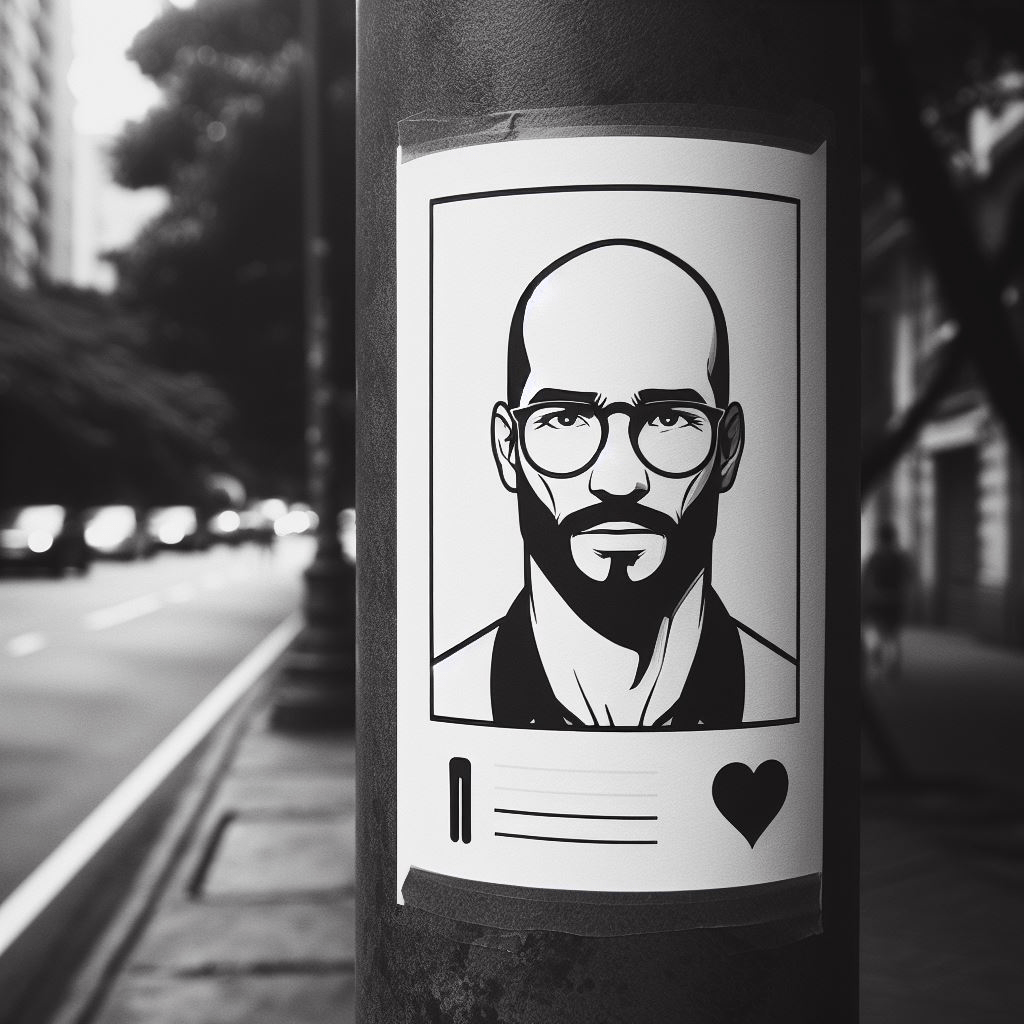
I used to think that lamppost announcements, whilst better than the General Channel in any given Microsoft Team, were a ridiculously scattergun way of trying to disseminate crackpot theories, overthrow a perfectly fair election, or find a missing loved one. But obviously they’re not, as I’ve just demonstrated by waffling on about them far in excess of the bounds of either good sense or good taste. And being of a ridiculously literal turn of mind – not so much that I am in danger of becoming a software developer, mind, but still worryingly literal – it occurred to me that maybe people should start sticking their dating profiles on lampposts.
According to studies that I Googled, didn’t read in their entirety and then chose selectively based on their out-of-context ability to back up a radically unsound hypothesis that I wished to advance, 75% of lost cats are eventually reunited with their owner (it occurs now that cats probably never think they are lost but assume it’s their owners who have failed to anticipate where they ought to be in order to best serve the cat’s needs). A local flyer campaign is described as one of the most effective components of a successful Felines United strategy.
By contrast, a 2023 Stanford study proposed that only around 40% of dating app victims found partners using swiping technology. The facts then are clear and indisputable; you would have far more romantic success if you stuck your dating profile to a local neighbourhood lamppost than if you stuck it in an app alongside your rushed answers to lame icebreaker questions (especially if that app was LinkedIn, which I refuse to believe has any use, let alone use in finding a life partner). I once wrote a short poem about Tinder, lucidly entitled “A Short Poem about Tinder“, which goes:
Tinder: pro tem monogamy.
A swiping economy
for serial dating sprees.
Love product placement,
Sex micropayments.
At this time of year, i.e. the start of January, I always spend time thinking about my New Year Resolutions as this seems the most propitious time of year to do so. I love the arbitrary nature of the idea that you’re going to make a wholesale lifestyle change based on buying a new calendar (what calendars do you buy? I always have my Alan Lee-illustrated Lord of the Rings calendar in the kitchen and an Olivia De Berardinis calendar in the office, as though pin-ups and hobbits represent the fundamental dichotomy of my gender identity). This year, I thought, “I’ll go on a date, but just one date”, so hopefully I don’t accidentally bump into my soul mate first time out. “Too bad,” I would have to say, “I think you’re probably the one I am meant to spend the rest of my life with but I’ve already decided that I’m only going on one date this year.”
My last date was about six months before lockdown, or six months less 15 minutes before the first COVID denial lamppost stickers appeared (I swear I’ve never typed the word ‘lamppost’ so much). First there was lockdown, then ‘Horizon Forbidden West’ came out, and ‘The Rings of Power’, then ‘Ahsoka’… there was always something in the way.
Actually, what I had consciously decided to do was not date. I was actively not using apps; purposely not asking friends to fix me up with their single friends; intentionally not flirting with strangers in bars; and whatever else dating used to be before real life became a LARP version of ‘Black Mirror’. To be perfectly honest, I was never one for talking to strangers (or people I know) in bars (or anywhere else). I can talk to strangers behind bars, which is to say I can talk to them when I am serving drinks rather than 25-to-life for forgetful homicide, which sounds much nicer than negligent homicide and lends it a sort of genteel, English countryside, cosy crime feel. But without that two feet of ring-stained wood between us, I can’t talk to people I don’t know in a social setting. I have repeatedly been accused of being a terrible flirt (terrible being the operative word) when I work behind the bar but it’s all an outrageous slur. The very idea is preposterous. I have no small talk. Someone says hello to me and thirty anxious seconds later I’m giving them a TED talk on poststructuralism, the demise of The Situationists, or the evidence for J, P and E primary sources in the first five books of the Old Testament. Ask anyone.
It’s quite a revolutionary act, I find, wilfully choosing not to date. It’s not a heteronormative thing – it can affect all orientations – it’s an amatonormative thing. A term coined by Elizabeth Brake in her book, ‘Minimizing Marriage’,
‘Amatonormative’ is used to describe the widespread assumption that everyone is better off in an exclusive, romantic, long-term coupled relationship, and that everyone is seeking such a relationship.
Brake, Elizabeth. (2012) Minimizing Marriage: Marriage, Morality and the Law, Oxford, Oxford University Press
If you’ve ever had someone say to you, “oh dear, just not found the right one yet?” or “isn’t it time you settled down?” or “how do you expect to find someone while you’re sitting there swiping on your bloody phone?”, you’ve experienced amatonormativity as a prejudice. It devalues other types of friendships, caring relationships, nonsexual relationships, even certain types of polyamorous relationships. But is it really that bad, that undervalued, that looked down upon, being on your own, if that’s what you choose for yourself?
I look at my cats – the small one who insists on being served food while she sits in a cardboard box on the kitchen table, and the large one whose resting ginge face forms the entirety of the definition of the word ‘disdain’ in the Oxford English Dictionary – and I think about the young lady patiently, diligently searching for her beloved cat around the neighbourhood, and think that people who use the amatonormative insult, “you’ll die alone with your cats” really don’t have the first clue what they’re talking about.
Over 16 people have subscribed to the newsletter already! If you want to be a member of one of the most exclusive clubs on earth, sign up below.

 It's a Queer Old Blog...