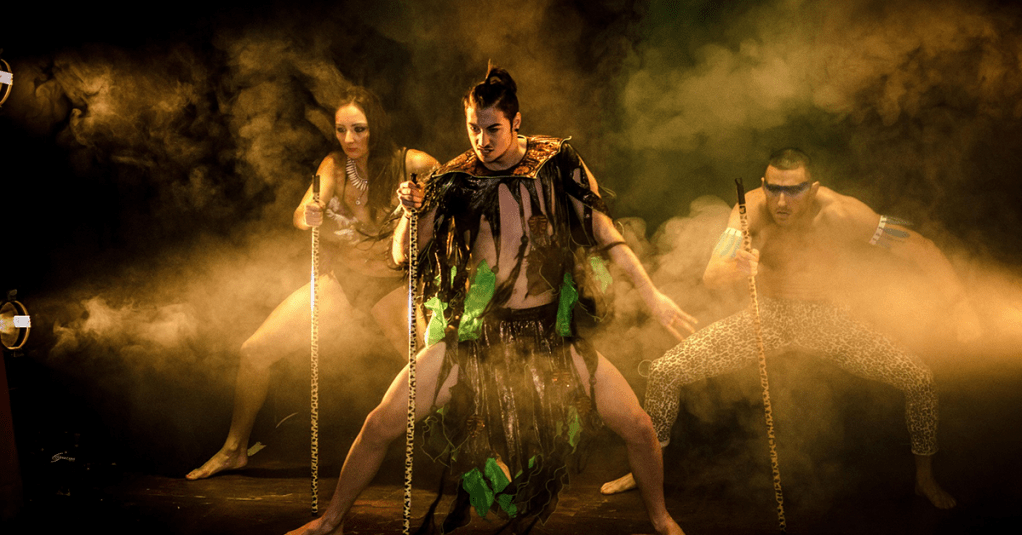
Because of the outward representation of my genitalia, I was a boy scout and my sisters went to dance class. Such was the way of the world in the 1980s, which differed from the world of the 1880s primarily via Top of the Pops. I was perceived as male even though I was the first boy in the north, not just the north of England but the north of any planet, to rock boat neck sweaters to secondary school. I swore my oath and dutifully took my proficiency badges in knot tying, preparing roadkill for eating, and making improvised jungle traps (strolling through our back garden was like traversing the set of ‘Southern Comfort’ (dir. Walter Hill, 1981)).
My sisters, not being male, went to dancing lessons and learned the choreography for ‘Thriller’. My Dad once told me that for a brief period there’d been the possibility of moving the family to Canada. I myself turned down the opportunity to live and work in Corfu over the summer to work as a nightclub DJ. But the only real regret I have is missing out on the opportunity to learn that zombified shoulder shimmy, slide and snap.
Around the time of ‘Thriller’ the older of my sisters and I were able to start going to under 18s discos, where we would establish a dancefloor beach head and hold out against occupying forces, double-timing our synchronised choreography to ‘Gimme Some’ and ‘Can You Feel It’.
As soon as I was old enough for underage drinking and clubbing, I took to dancefloors like a politician takes to WhatsApp. This was the Second Summer of Love, when city centre cattle market nightclubs with names promising magic and sex (“Phantasmadildo’s”) were trying to embrace smiley rave culture whilst simultaneously enforcing tucking your shirt into your trousers (no jeans, no trainers). I was once thrown out of a nightclub and the bouncers, now repurposed as the Fashion Stasi, caught me untucking my shirt to dance. Well, joke’s on you, Xanadu nightclub, because I still exist and you don’t. My therapist assures me I do.
Throughout these years, I danced a lot. I danced in the way that Leland Palmer dances after killing Maddie in Twin Peaks, which is to say that I danced compulsively rather than homicidally, although I fear that lives could have been lost to flailing limbs every time the chorus of Oceanic’s ‘Insanity’ dropped. The worst dancing injury I can recall suffering myself was a twisted ankle dancing to ‘Firestarter’. My housemate Kerry and I were having a pre-going out rave at home and I launched myself from the open plan staircase to the floor and missed. To this day, the opening guitar of ‘Firestarter’ brings me out in cold sweats and colder compresses.
The recorded history of dance goes back at least 10,000 years which coincidentally is when I was last on a dancefloor in public. I don’t want to bore you with specifics but it seems like something possibly happened at some point, maybe in the run-up to my turning 30, or potentially at some other time, but certainly around age 30 I hit a wall and, like Mance Rayder, my attempts at breaching it were extremely unsuccessful. I hit the wall and I stopped dancing.
Up until this point dance had meant one of two things to me. It would either be a solo form, a sort of rhythmic showing-off set to music, typically around the kitchen. In fact this is still how I cook today; all of my dishes are in 4/4 time. Following Sophie Ellis-Bextor’s lead my kitchen is disco first, kitchen second. I also love synchronised group choreography. It’s interesting to watch modern contemporary dance, and I love the intricacies and technicalities of Latin and Ballroom, but give me a group moving as one any day. When you think about it, and I imagine most don’t think that deeply about a longform music video released, coincidentally, 40 years ago this month, but these two forms of dance are the essence of the ‘Thriller’ video. On the one hand you have Michael in human form, gloriously camping it up and sashaying around Ola Ray on the street. On the other, you have the military precision of the group zombie-off; 28 Bars Later.
Fast forward to 2020-ish and, having become a firm fan of ‘Strictly Come Dancing’, I resolved to find myself a dance class. I’d gone the best part of two decades without dancing, in public at least – in private I can barely open a packet of Dreamies for the Cats without a fleckerl (the little Cat is so addicted to Dreamies that she pricked up her ears even as I typed the word).
There were missteps, literally and many, along the way. I gave up salsa when the realisation dawned that I would have to let strangers touch me (or, “dance with a partner”, as the instructor misleadingly phrased it). I tried a street dance class for beginners, but their definition of ‘beginner’ was very different to any that I’d previously come across and did not describe me. I took part in a Voguing workshop, an art form I had long been interested in, but Voguing is pure self-expression and I needed a more structured form of showing off even as much as I loved the workshops. That was the point at which I found burlesque classes – neo-burlesque, I suppose – which is perfect for me. It fulfils all criteria of high camp and high art and gives my ambiguous (even to me) gender identity full rein. Burlesque is dance and drag, politics and playfulness, satire and sexuality, all in three-and-a-half tightly choreographed minutes.
What it also is, is self-care. I never discussed it with her, but I have a theory and I bet my therapist would nod meaningfully but ambiguously and then ask me how I feel about it. Up until my early twenties I had never thought to question my gender; you don’t, do you, up until the point that you become aware that your experience (of anything) is different from how you perceive other people to experience it. Clause 28 came into effect just before I turned 18 and began to spread its insidious poison, taking us back to the 1880s. The effect on sensible discussion on gender and sexuality was pernicious and long-lasting, and it sent people back into closets relating to gender and sexuality from which they would not emerge for a long time. I stopped dancing. I could not be dragged onto a floor at weddings or Christmas parties. I was so incredibly self-conscious, after years of being the first one on the dancefloor.
Looking back I realise that I wasn’t able to think intelligently about topics like gender and sexuality until a convergence of things, much later in life. I started spending time in Brighton and mixing with people and communities who didn’t think that wearing a pink shirt was a cast iron indicator of homosexuality; I learned a whole new lexicon relating to gender and sexuality; and I was exposed to new influences outside heteronormative mainstream media, in particular RuPaul’s Drag Race where I heard a hundred other outsider stories. Then, lo and behold, after a few years of exposure to positive influences and people with experiences and knowledge to which I could relate, I find that I am once again comfortable and confident enough to practise activities that bring me joy without worrying about what other people thought. That is self-care, and it’s also why representation matters so much to minority groups.
Statistically there must be much worse things to do on the Internet than subscribing to my newsletter. If I think of any, I’ll blog about it, and you could read about it on the newsletter after you subscribe? That is some Inception-level shit going on.


 It's a Queer Old Blog...